


Simplified issue life insurance lets you get approved for coverage in as little as 24 hours by answering a short health questionnaire instead of taking a medical exam. No blood draw, no urine sample, no visit from a paramedical examiner. For seniors and busy adults who need protection in place fast, that trade-off of a few honest answers for a quicker yes is often worth more than saving a few dollars a month on a fully underwritten policy.
This guide breaks down exactly how simplified issue underwriting works, what carriers ask, what it costs compared to other options, and how to tell whether it’s the right fit for your family before you apply.
What Is Simplified Issue Life Insurance?
Simplified issue life insurance is a life insurance policy issued without a physical medical exam. Instead of scheduling a nurse visit for blood and urine samples, you answer a short set of yes-or-no health questions on the application. If your answers and background records check out, many carriers approve coverage the same day.
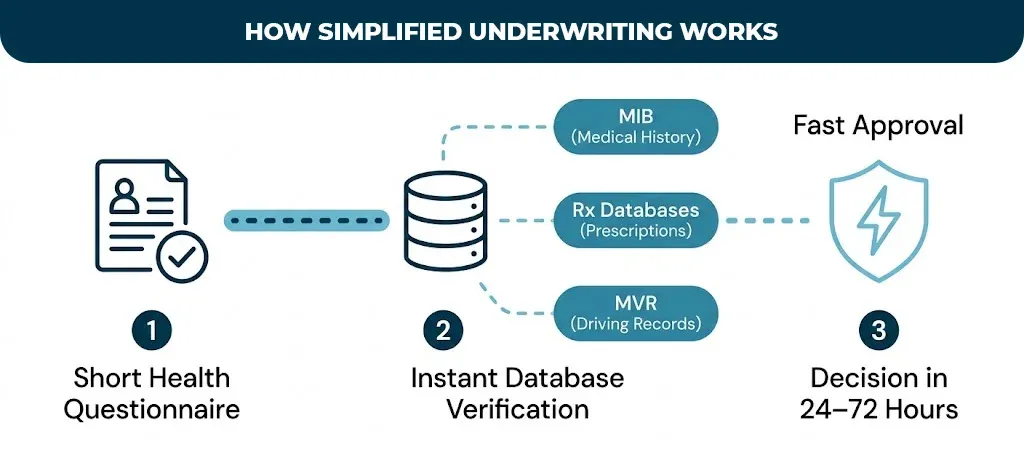
That doesn’t mean insurers are flying blind. Behind the scenes, they cross-check your application against three main data sources:
- MIB (Medical Information Bureau) records a shared database that flags prior insurance applications and reported health conditions.
- Prescription drug history (Rx databases) pharmacy records that reveal medications tied to conditions you may not have disclosed.
- Motor Vehicle Records (MVR) driving history, which insurers use as a proxy for risk-taking behavior.
This behind-the-scenes verification is what allows carriers to skip the exam without skipping risk assessment entirely; it’s a faster underwriting model, not a rubber stamp.
Simplified Issue Term vs. Simplified Issue Whole Life
There are two main product types sold under this umbrella:
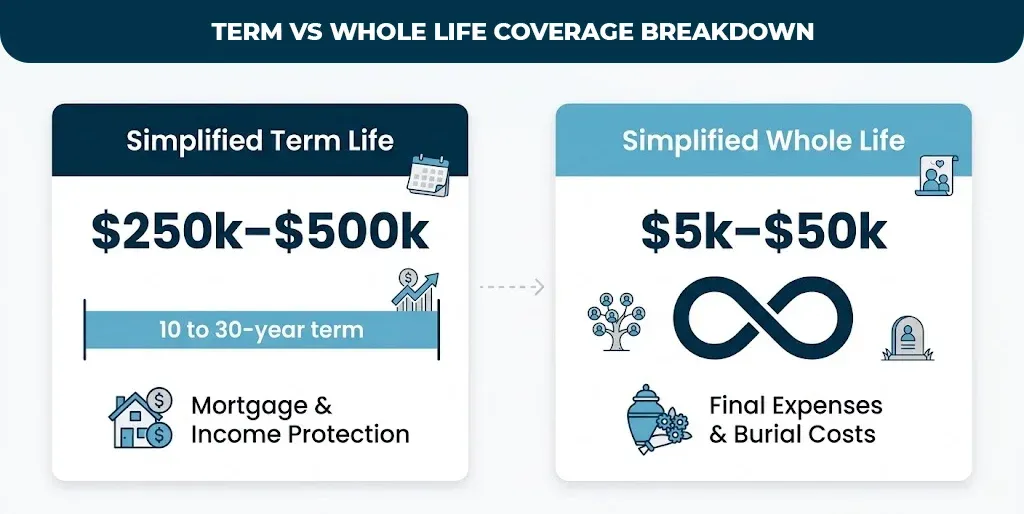
- Simplified issue term life insurance (also called simplified term or simplified issue term insurance) temporary coverage, usually 10 to 30 years, with higher available face amounts, often up to $250,000–$500,000. This is a common choice for income replacement or covering a mortgage.
- Simplified issue whole life insurance (simplified issue permanent coverage) lifelong protection that builds cash value, frequently sold as a small term life insurance policy alternative for final expense or burial costs, typically in the $5,000–$50,000 range.
How Simplified Issue Underwriting Works: What to Expect
Most simplified issue applications move from submission to decision in 24 to 72 hours. Compare that to four to eight weeks for a fully underwritten policy that requires a paramedical exam, lab results, and an attending physician statement. The speed comes from replacing in-person testing with a questionnaire plus instant database checks.
Common Health Questionnaire Topics
While the exact wording varies by carrier, most simplified life insurance applications ask about:
- Whether you’re currently hospitalized, in hospice, or receiving long-term care.
- Major diagnoses in the last two to five years cancer, heart attack, stroke, or COPD are common lookback triggers.
- Whether you need help with Activities of Daily Living (ADLs) such as bathing, dressing, or eating.
- Current prescriptions and any terminal illness diagnosis.
Answer honestly. A misstatement discovered during a claim inside the policy’s contestability period, typically the first two years can lead to a denied claim or a reduced payout.
Possible Decision Outcomes
- Instant approval of your answers and database checks are clear automatically.
- Manual underwriter review a person looks at a borderline answer before deciding.
- Decline or referral you’re pointed toward a guaranteed issue policy instead, since those ask no health questions at all.
Simplified Issue Life Insurance Pros and Cons
Before choosing a simple life insurance policy over a fully underwritten one, weigh the trade-offs directly.
Advantages
- Speed. Approval in days, not weeks is useful when you need coverage in place for a new loan, a divorce decree, or peace of mind right now.
- Convenience. No examiner visit, no needle, no chasing down old medical records from a doctor you saw a decade ago.
- Accessibility. Easier to qualify with well-managed conditions like controlled hypertension or type 2 diabetes than under strict fully underwritten guidelines.
Disadvantages
- Higher cost per dollar of coverage. Because the insurer takes on more uncertainty, premiums typically run higher than a preferred or standard fully underwritten rate for the same face amount.
- Lower coverage caps. Most simplified issue term life policies top out well below what a healthy applicant could get through full underwriting, and whole life versions are capped even lower.
In short: you’re paying a premium for speed and simplicity, not for the cheapest possible rate.
Simplified Issue vs. Guaranteed Issue Life Insurance
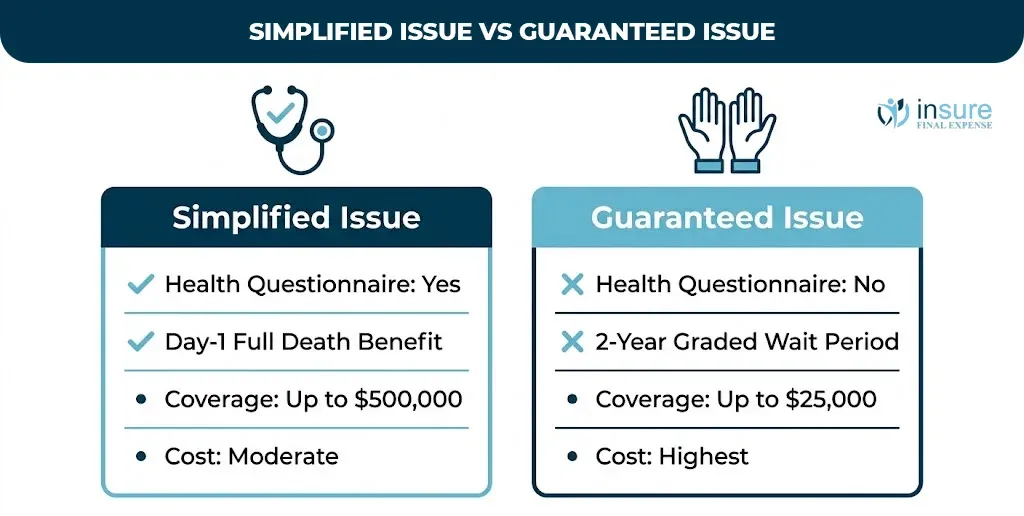
These two “no exam” categories get confused constantly, but they work very differently. A simplified issue policy asks health questions and can decline you based on the answers. A guaranteed issue policy asks for near-universal acceptance, usually within a set age range.
The catch with guaranteed issue coverage: most policies include a two-year graded death benefit. If the insured dies of natural causes within that window, the policy typically returns paid premiums plus interest rather than the full face amount. Simplified issue policies, by contrast, generally pay the full death benefit from day one.
Feature | Simplified Issue Life | Guaranteed Issue Life |
Medical exam required? | No | No |
Health questionnaire? | Yes short list of questions | No zero health questions |
Coverage payout | Full death benefit from day one | Usually a 2-year graded benefit |
Maximum coverage limit | Higher often $250,000 to $500,000 | Lower usually capped near $25,000 |
Relative monthly premium | Moderate | Highest per $1,000 of coverage |
If you can pass a short health questionnaire, simplified issue insurance is almost always the better value than guaranteed issue coverage, lower premiums, a higher payout ceiling, and no graded benefit waiting period.
Who Should and Shouldn’t Buy Simplified Issue Life Insurance?
Good Fit
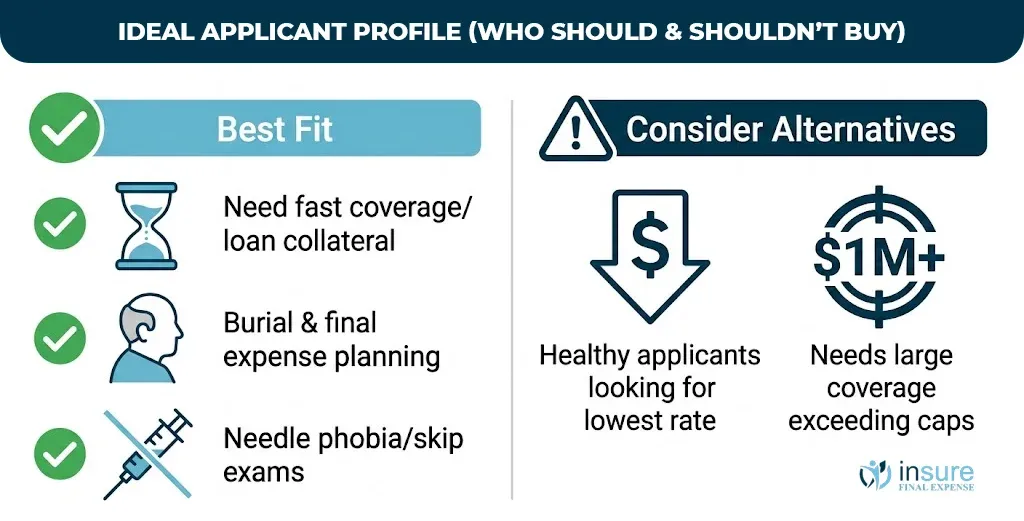
- Seniors who want final expense or burial coverage in place quickly.
- Anyone with a needle phobia or significant medical anxiety.
- People who need coverage fast for loan collateral or a divorce settlement deadline.
- Applicants with mild, well-controlled conditions who’d rather skip a physical exam altogether.
Consider Alternatives Instead
- Healthy applicants who could qualify for preferred or preferred-plus rates on a fully underwritten term policy the savings over 20-30 years can be substantial.
- Anyone needing a large death benefit, such as $1 million or more, for income replacement simplified issue face amounts cap out well below that.
The Bottom Line on Simplified Issue Life Insurance
Simplified issue life insurance exists for one reason: to close the gap between needing coverage and actually having it, without the delay of a medical exam. It costs a bit more per dollar of protection than a fully underwritten policy, and the coverage ceiling is lower but for final expense planning, loan requirements, or anyone who simply doesn’t want to deal with a paramedical visit, that trade-off makes sense.
Before you apply anywhere, compare quotes side by side. At Insure Final Expense, we specialize in matching people with simplified issues and final expense policies that fit their health profile and budget without the runaround. Get your free, no-obligation quote and see your real options in minutes.

Expert Final Expense & Life Insurance Agent
Steffanie is a licensed life insurance specialist at Insure Final Expense, focusing on final expense, burial, and senior life insurance solutions. With years of industry experience, she helps families secure affordable coverage designed to protect their loved ones from financial hardship. Her content is carefully researched, compliance-focused, and created to provide clear, trustworthy guidance so readers can make confident insurance decisions.